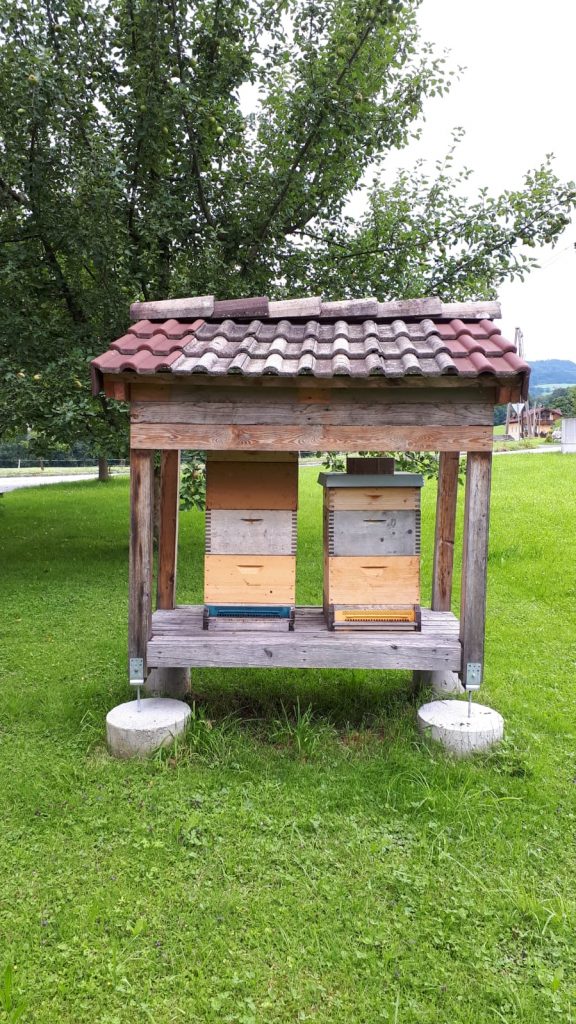

It’s been a long time since I got in touch with you. Corona has also paralyzed our village. No guests were able to visit us. Our restaurants and inns were closed, as were the accommodation facilities.
But now our beautiful village is shining again, summery and blooming. Yes, blooming! Have you also noticed that more and more farmers are deliberately not mowing individual meadows? Have you also noticed this new trend of mindfulness? This feeling of closeness to nature has finally arrived (also thanks to Corona).
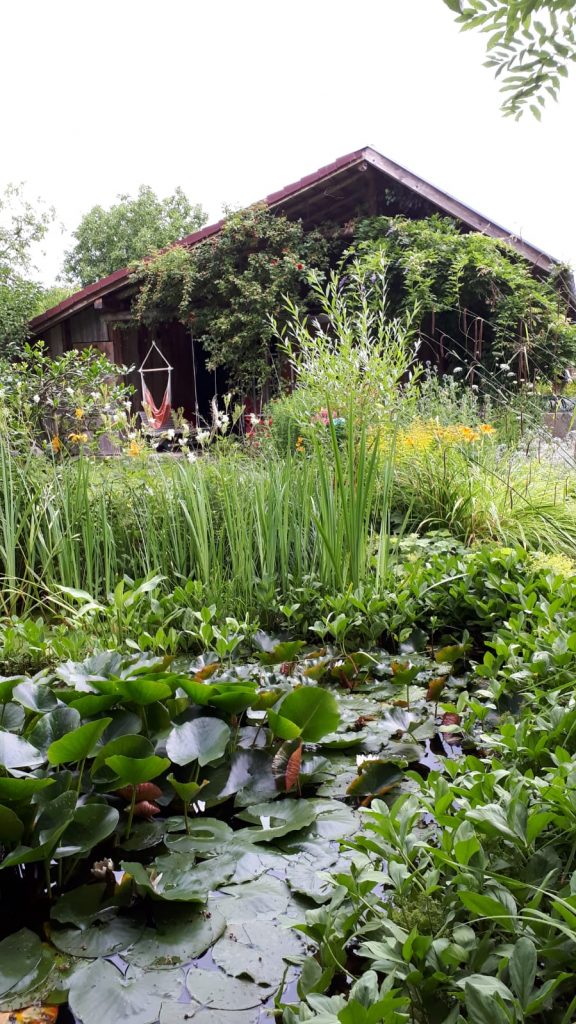
This is particularly pleasing for beekeepers and their colonies.
There are almost 20 beekeepers in Anthering, whose joy in these industrious animals is palpable as soon as you talk to them – in other words, to the beekeepers. J
Bees also talk to each other – but they keep to themselves. A bee flies up to 3 km in a radius to collect the best nectar. And in a bee’s lifetime, it flies around the world almost 3 times. They can only fly when the temperature is above 10 degrees. So there’s no flying in winter. Once she has found a good place to collect the valuable gold, she notifies her colleagues with a “tail dance”. How it indicates where it has just been, what it has found and how far away this spot is is a mystery to me – but if the flower is found to be good, it can happen that one and the same bee flies to this spot several times.
The first beekeeper I invited to talk to me was my dear grandfather, Hans Maier. He had beehives for many decades. Up to 20 colonies, he says! He talks about the past, when the grass wasn’t mowed as often as it is today. The bees had a lot to do and the yield for the beekeeper was plentiful. There were times when he was allowed to extract honey every week – that’s how industrious his bee colonies were.
Today, the great variety is limited to spring. The trees are in bloom, the dandelions are lush in the meadows. When the wild garlic blooms and the bees feast on it, you can even taste it in the honey – that’s how intense the “source material” is here. And: the forest “honeys” – that was new to me. The bees harvest, so to speak, after the work of an aphid that “nibbles” on trees – that’s what Hans calls it.
What pleases Hans is that a lot is being done in Anthering to protect the bees. Particularly in the Antheringer Au, care is taken to ensure that there are enough flowering plants. Only what is absolutely necessary is mown. In the village, the herb garden in particular offers a never-ending reservoir of fragrant flowers.
I found it particularly interesting that the bees also find many flowers in the cities. The main reason for this is the cemeteries. There is always something blooming here. And the surrounding nurseries also offer a lot for the bees. Landscaped gardens such as the Mirabell Gardens in nearby Salzburg or the beautifully planted traffic circles of the city nursery are also suitable places for the bee colonies to approach. Many a beehive can therefore be found on balconies – in the middle of the city.
The more Hans tells me, the more enthusiastic I get about bees. And he sends me to Simon Gschaider, he could tell me a lot more about beekeeping.
Simon has his bee colonies in Ried, a higher part of Anthering. And he also talks about the forest that “honeys” – the sieve tubes of the fir are stung by aphids, the sap that is then produced in abundance is coveted by the bees. It’s teamwork – the aphid stings, the bee harvests. Tree leaves also give off honeydew, which is collected.
Bees take the sap from trees and/or the nectar from flowers back to the hive in what is known as the honey stomach. And that sounds strange – the bee spits the sap out again via its proboscis, so to speak. Namely into the honeycomb – where it is then capped – with a putty resin that the bee also brings from the trees. Known as our PROPOLIS. That’s what it’s called once the industrious little worker bee has made it.
What is visible to us – are POLLEN on the bee’s legs. This is the food for the young. Healthy for humans – but hard for us to get.
Every beekeeper looks after his swarms and knows their peculiarities. Simon says there are days when he prefers not to get too close to them. If the weather isn’t right, or he himself was restless on his last visit, he can tell by the bees’ aggressive behavior. Then he sometimes goes home with stings.
There is always something to do in the hive.
Active control of the varroa mite in particular is now an obligation for every beekeeper. It is important to learn how to deal with them.
And when there’s nothing to do, Simon simply watches the bees – and learns more and more about the behavior of the animals.
Simon talks about worker bees, guard bees, drones and a queen. The tasks are divided up very precisely. The worker bees clean, fly out and bring back the precious cargo (putty resin, nectar and pollen). And they look after the brood. The “lazy Willi” is no coincidence – the men do practically nothing! They let themselves be fed, only fly out to mate – and that’s it for drone life. The queen, or queen bee, is the only sexually mature animal in the hive and lays the eggs.
What I didn’t know was that there are summer bees (life expectancy 3 weeks) and winter bees – they live up to half a year.
A new subsidy from the Province of Salzburg – for smaller meadows that are not mowed – is very welcome. This measure also applies here in Anthering, to the delight of the bees.
I’ll tell you what, these beekeepers have a knowledge that impresses me beyond belief. Listen to them when you’re here in Anthering. Just stop when you see a beehive, the beekeepers will be happy to tell you what there is to do. The passion for bees / honey / brood / rearing – will grab you too.
And don’t forget – bees and insects are our most valuable asset. We humans need them to survive – who else would pollinate our flowers so that they become fruit?
See you soon, your elf!