

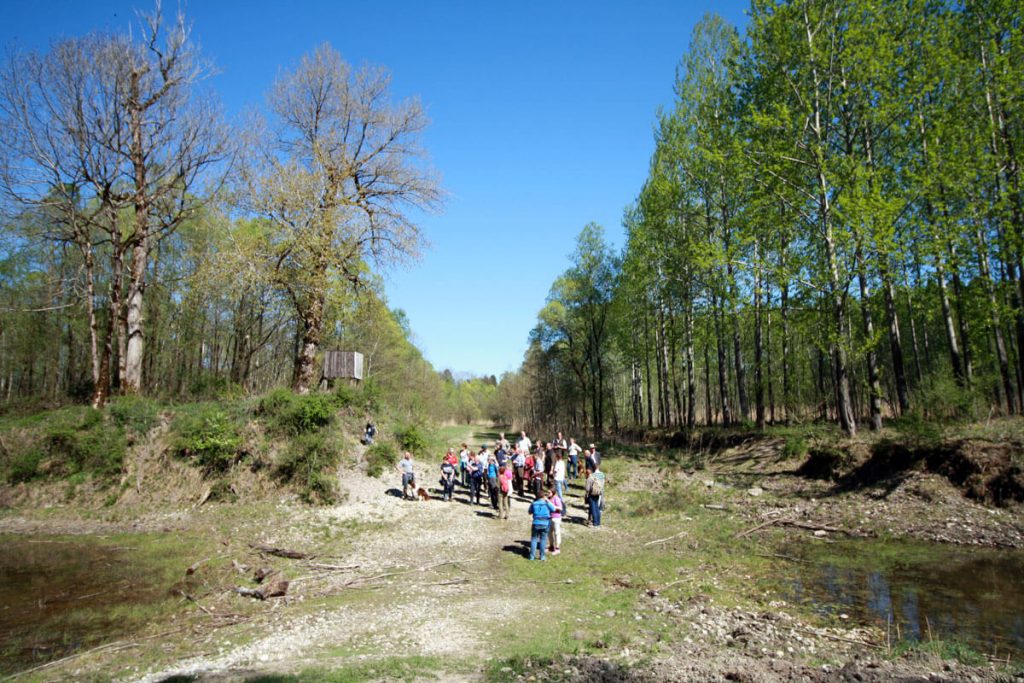
Welcome to spring! Have you heard of the “Green Event” – what is that? It has to do with “green” and a “festival”. What is being celebrated? Well – I had a good look at it on Good Friday.
It’s about the forest – and not just about how beautiful our forests are, but how worthy of protection and alive.
In my home town of Anthering, the tourism association is working with a forest educator and the local forester on this topic and welcomes GUESTS to the forest. A great idea – to pass on what a jewel we have there and how we can make the best possible use of it, but also protect it. Only those who know WHAT to protect will do so.
Forest habitat
The meeting point is right at the entrance to the Antheringer Au – it’s a pleasure to see how many people are interested in this topic – a large group sets off into the forest.
Sepp Unterberger, the local forester, seems to know every tree personally. He almost lovingly explains how to handle wood and branches when one of his protégés has to be felled. But why does it come to this?
Pests such as the bark beetle are causing problems for the spruce trees. The vitality of the trees is being systematically overridden. This 8-toothed “book printer” reproduces so quickly that the natural enemies have no chance of coping with these numbers. The story of its reproduction sounds romantic. The first meeting point is the “gathering chamber”, the pairs want to be undisturbed, the larvae grow in the mother chamber and then eat their way out. In just a few weeks, the game starts all over again. And so only 3 generations produce: Millions of little beetles. This spruce wood is wrongly sold as “beetle wood” – the boards made from it are perfectly fine. The tree only has to be felled because of the massive damage to the bark.
I find the mighty solitary spruces very impressive – an old stand with trunk diameters of up to 1.2 meters. The animals find shelter here during rain and storms. Or they provide cool shade in the summer months. They are also considered breeding trees for eagle owls, for example.
Everyone is also talking about ash dieback. Ash trees fall victim to a fungus – tiny fruiting bodies visible to the eye, whose spores are carried by the wind onto the leaves of other ash trees. There they close the pores and the ash trees die. They also penetrate the trunk and interrupt the sap flow. If the ash tree is affected in this way, it cannot survive and must be felled in a planned manner before it spontaneously falls over and possibly causes damage.
On our tour, we see a lot of felled ash trees and a light-flooded forest that is currently being replanted with English oak and sycamore. Incidentally, ash wood is very suitable as firewood – just like copper beech.
Animals and their tracks
Another problem for forestry in the forest is the immensely fast-growing Canadian goldenrod – it grows 2 meters per year and deprives the young forest of light.
We all learn how important the work of the foresters is and how respectful the approach is. Caring for wildlife and animals is also part of this – wild boar, fallow deer and countless species of birds have found a home here in the floodplain.
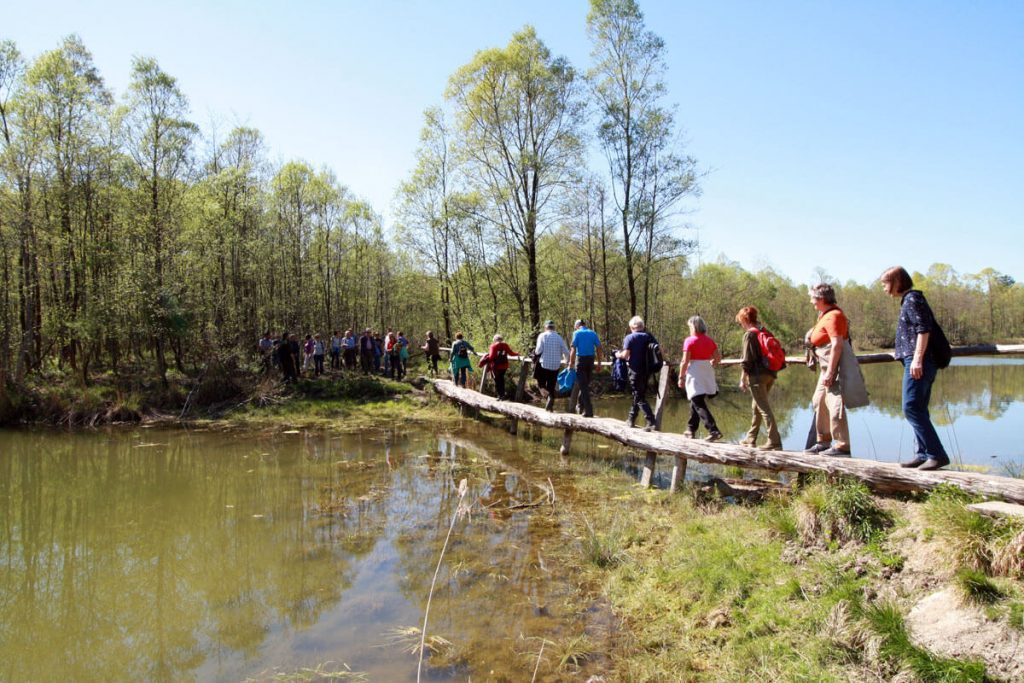
And another one clearly feels at home here – the beaver in its castle. On the path around the renaturalized gravel ponds, we see what a beaver “accomplishes” in just one night. He cuts down trees – and not small ones – no, he chooses trees with a beautiful crown – because he needs the tops for his den. The population in the Antheringer Au is currently estimated at around 30 animals.
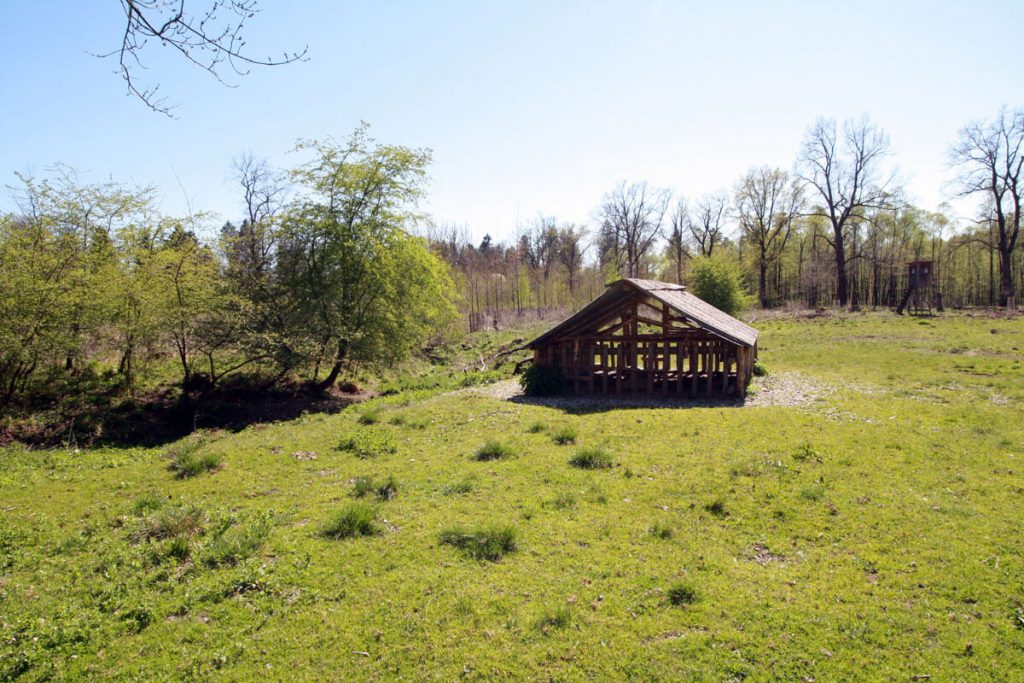
Accompanied by a frog concert and the cuckoo’s first cry of the year, we hike on towards the Tonkerhaus. We have been walking for more than 2 hours – and there is still so much to discover.
During a refreshment break, forest educator Manuela Haberlandner tells us about the origins of “forest bathing”, which is now also popular in Europe. In Japan, forest bathing is very important for health – so valuable that doctors even prescribe it. But it’s “only” about the healthy air in the forest. Well, we’ve known that for a while – haven’t we?
Anyone who thinks the guided tour through the forest is over is wrong. There is a very exclusive surprise for our group!
Sepp Unterberger has brought along a treasure – the 1952 police commando car, the Cobra of the 1950s, so to speak. It is a bus with open side doors.
We are invited to go for a ride – and let me tell you, it felt like an Anthering safari! From the bus we saw partridges, wild boar and fallow deer.
My personal thanks go to Manuela and Sepp – in just a few hours you showed us all how important forest care is, how valuable the clean air in the forest is for us humans and the animals, how diverse the Antheringer Au is, and how worthy of protection our forest is.
See you soon, your elf!